
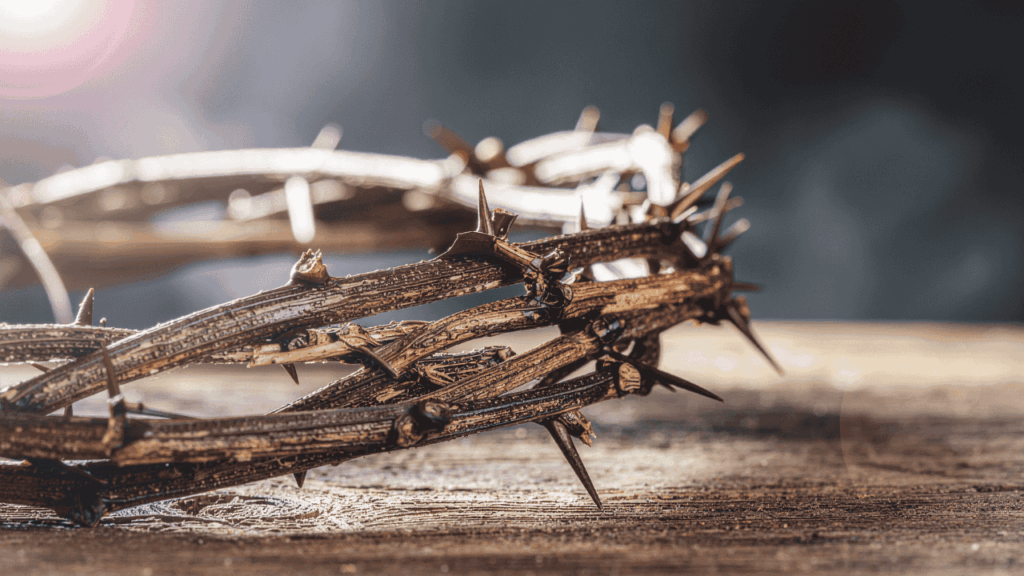
Pilate had sentenced the Lord Jesus to death by crucifixion and had Him flogged. As an abused man doomed to death, the Savior now became a plaything of the Roman soldiers.
The whole cohort (about 600 soldiers) was called together. The soldiers had probably picked up this much: that the condemned man was regarded as King of the Jews. What could be more obvious than to make this royal dignity look ridiculous?
The King of the Jews is made ridiculous
First they stripped the Lord Jesus. How humiliating and dishonoring that alone is!
Then they threw a “scarlet robe” around Him (Matthew 27:28). Such a purple cloak was the expression of a special rank and dignity, especially for kings and emperors. Here, however, it was used to mock. Dressed like a king—and at the same time an apparently defenseless plaything in the hands of the Roman soldiers: this made clear what they thought of such a king.
An expression of royal glory is certainly also the royal crown. Instead of valuable materials such as gold and precious stones, the soldiers braided a crown of thorns. Thorns are a symbol of the curse that God brought upon the ground because of the sin of the first human couple. What pain was caused by putting on the crown made of hard, dry Oriental thorns? The Roman soldiers certainly did not handle the Lord Jesus gently!
Crowned in mockery with thorns,
no disciple followed anymore,
betrayed and denied,
only enemies around You.
The scepter, a splendidly decorated ruler’s staff, is a symbol of royal power. This mark of kingship, too, was ridiculed by the soldiers: they put a “a reed in His right hand” (Matthew 27:29), perhaps a worthless papyrus reed, fragile and easy to bend. That is how easy it was, in their eyes, to destroy this king and his kingdom as well.
The King is mocked, spat on, and struck
To the king “equipped” in this way, the soldiers then showed hypocritical respect and homage by falling on their knees before the Lord Jesus. They said mockingly: “Hail, King of the Jews!” (Matthew 27:29)! Literally translated, this greeting means: “Rejoice!”—What viciousness the human heart is capable of!
After that, the soldiers spat on the Lord Jesus—an expression of deep contempt. It is hard to show a person more clearly that you think absolutely nothing of him. Our Lord endured this despicable treatment without defending Himself—although He could have defended Himself!
If up to that point the soldiers had confronted the Lord Jesus with mockery and scorn, now they became physical: “They took the reed and began to beat Him on the head” (Matthew 27:30). We can probably assume that the crown of thorns was still on that head. And now they struck it—not only once, but repeatedly, as the Greek tense of the verb used makes clear. We can perhaps faintly imagine how painful that must have been. This image may have prompted the poet to write down the following stanzas:
O Head, once full of bruises,
So full of pain and scorn,
Mid other sore abuses
Mocked with a crown of thorn;
O Head! e’en now surrounded
With brightest majesty,
In death once bowed and wounded
On the accursed tree.
Thou Countenance transcendent!
Thou life-creating Sun!
To worlds on Thee dependent —
Yet bruised and spit upon:
O Lord! what Thee tormented
Was our sin’s heavy load,
We had the debt augmented
Which Thou didst pay in blood.


Comments (0)
No comments yet.