
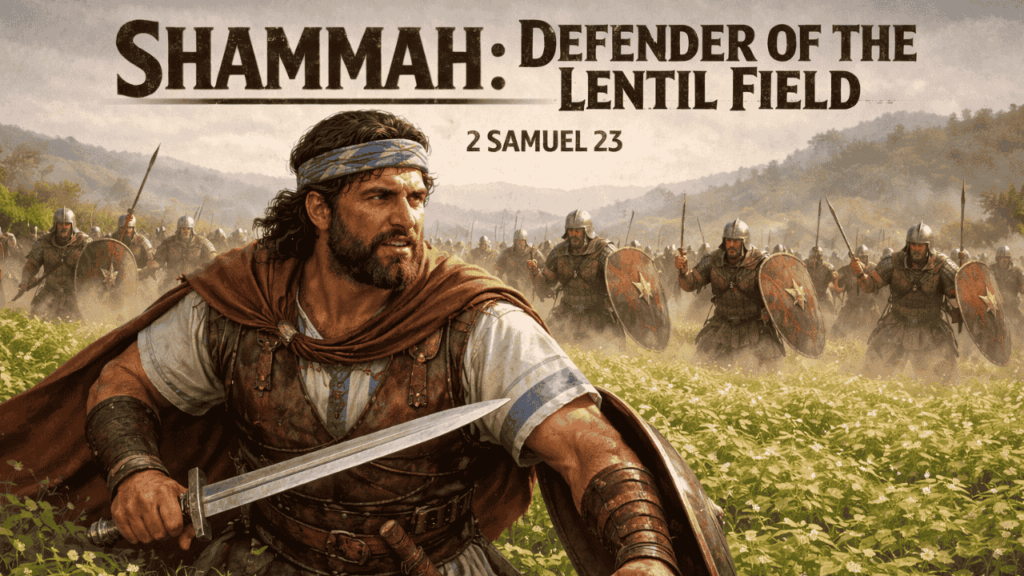
Shammah was one of David’s heroes, as recounted in 2 Samuel 23. In his last words, David thought once again of what these brave men had done for him. This included Shammah’s heroic deed. When Israel was attacked by a band of Philistines, Shammah was the only one who courageously defended himself and a field full of lentils. We too can learn from Shammah’s heroic deed. I would like to highlight four points in this context.
The field was part of the Promised Land
Shammah risked his life for a field full of lentils. Would you have done the same? Would you have risked your life for an insignificant field of lentils? The Israelites at that time thought it was not worth fighting for this field. But Shammah fought for it. For this field was not just any field. It was a piece of the Promised Land that God had given to His people as their inheritance. That is why it was so valuable to Shammah. That is why he was willing to risk his life for it.
When we consider that the Promised Land speaks of our position in Christ and the spiritual blessings that come with it (Eph. 1:3), we realize that the field Shammah defended also has something to say to us. Are we willing—as Jude expresses it in his letter—to contend for the faith that was once for all delivered to the saints (Jude 3)? Or to put it another way: What significance do the truths of faith that we find in the Bible have in your life and mine? Is it a matter close to our hearts to take practical possession of the spiritual blessings of faith and defend them against the attacks of the enemy (Eph 6:12)?
The field bore food for the people
The field that Shammah defended was not fallow, but bore lentils. To survive and withstand the Philistines’ attacks, the Israelites needed food. Shammah understood this. And in doing so, he apparently did not think only of himself, but had the welfare of others in mind, for he defended not only the amount of lentils he needed for himself, but all the lentils that were in the field.
Believers also need food, food for their souls. They find this food exclusively in the Word of God. The person of the Lord Jesus is the only food that truly nourishes believers (John 6:35). Focusing on Christ is the food we need every day. Let us ask ourselves: Do we search for him daily in the Scriptures to find spiritual nourishment for ourselves and others (Luke 24:27)? Do we “fight” to find time and opportunities to engage with the Word of God? And do we bring the nourishment we have gained from God’s Word to safety from the enemy (Judges 6:11)?
Shammah stood in the middle of the field
Shammah did not defend the field from the side, but stood in the middle of it. This was obviously the best position to defend the field against the enemy’s superior forces. If he had stood on one side of the field and fought, it would have been easy for the Philistines to enter the field from the other side and take possession of it. But from the middle, he could defend it on all sides.
We can only defend what we possess. This is no different in the spiritual realm than in the natural realm. Only the blessings and truths of Scripture, which we have set our feet upon in faith and taken possession of, can we defend against the attacks of the enemy (Joshua 1:3). On the other hand, truths that we want to defend from the side (that is, truths that we have grasped with our minds but not really with our hearts) can easily be taken away from us again. How many truths of Scripture have we set our foot squarely upon?
The LORD brought about a great deliverance
Humanly speaking, Shammah fought a hopeless battle. All alone, he defended a piece of land against a superior number of Philistines. But the Lord saw this man’s courage and determination and rewarded his faith. What seemed doomed to failure from the start ultimately became a great victory. Shammah “struck down the Philistines,” and the Lord brought about salvation.
The Lord also wants to reward our courage in faith. He takes note when, in the hustle and bustle of everyday life, we still find the time and spiritual energy to engage with His Word. He also does not overlook us when we fearlessly stand up for the truths of faith we have learned from the Bible and defend them against the enemy’s attacks. Those who rely on the statements of His Word in faith and stand up for them can still experience the Lord’s help and salvation today. God has recorded Shamma’s heroic deed forever in His Word. He will not forget our “work” either and will richly reward us for it one day (Hebrews 6:10). May the Lord also grant us the courage of faith and the determination of a Shamma!
10Finally, be strong in the Lord and in the strength of His might.









Comments (0)
No comments yet.